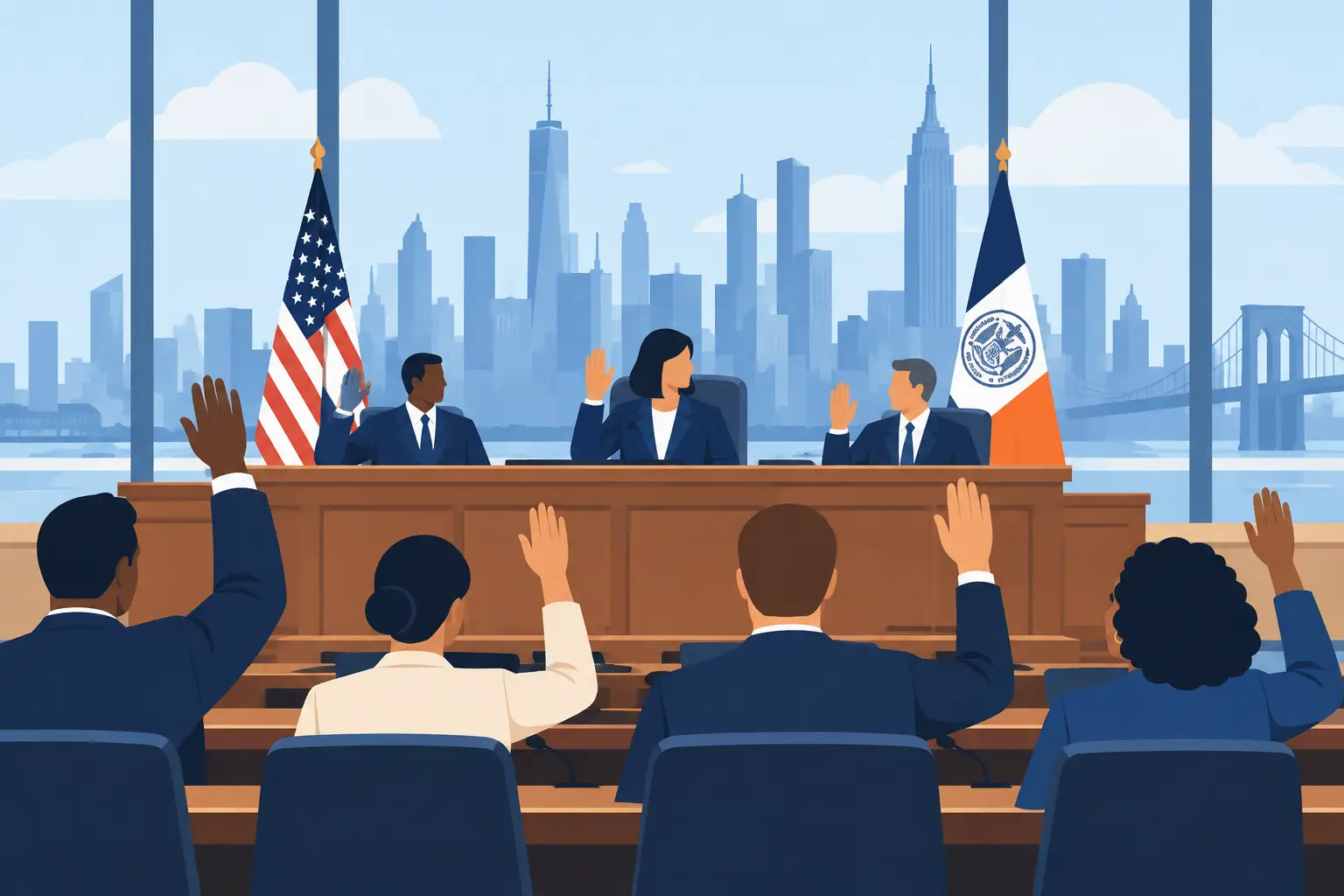
A Council press release can make a measure sound finished before it is. A committee may have advanced it. Council members may have announced support. The Mayor may have endorsed the idea. None of those developments is the final legislative act. To understand when council votes occur, New Yorkers need to distinguish between a hearing, a committee vote, a full Council vote, and the separate steps that can still follow.
That distinction matters because City Hall accountability depends on the record. A promise is not kept because it was introduced. A bill is not law because it was discussed. The public should be able to identify the exact meeting, vote count, members present, and final status.
When Council Votes Occur: The Basic Calendar
New York City Council votes generally happen at two levels: in committees and at meetings of the full Council. The Council publishes a legislative calendar and meeting notices, but the practical answer is not simply "on a certain day each month." Vote timing depends on the type of action, the committee schedule, negotiations among members, and procedural deadlines.
A full Council vote usually takes place at a stated meeting, the formal gathering at which the 51-member body considers legislation reported out of committee. These meetings are where the public most often sees final passage of bills, resolutions, land-use actions, appointments requiring Council approval, and other items on the agenda.
Before that point, a committee usually does the first substantive work. The relevant committee may hold a public hearing, question agency officials and advocates, consider amendments, and vote to approve or reject a measure. A committee hearing and a committee vote can occur at the same meeting, but they do not have to. Some proposals are heard and then held for later action. Others move quickly when the policy and votes are already aligned.
The Council's calendar is the controlling document, not political speculation. Agendas can change, items can be laid over, and a measure that appeared ready for passage can be removed while negotiations continue. Checking the final agenda and the official meeting record is more reliable than treating an early announcement as a completed action.
A Bill Does Not Reach the Floor by Accident
Most local laws begin when a Council member introduces a bill. The bill is referred to a committee with jurisdiction over the subject, such as Housing and Buildings, Sanitation, Transportation, Education, or Finance. Referral is a starting point, not proof that the measure has momentum.
The committee chair, working within the Council's leadership structure, determines whether and when the bill receives a hearing. At that hearing, the public can testify, agencies can provide their position, and members can establish a legislative record. This is often the point at which a proposal becomes visible. It is also the point at which many proposals stall.
If a committee votes to approve the bill, it can be reported to the full Council. The Speaker then has a central role in scheduling floor consideration. A favorable committee vote is significant, but it is not final passage. The full Council can approve, amend, postpone, or decline to take up the item.
For ordinary local legislation, passage generally requires a majority of the full Council - 26 votes if all 51 seats are filled. The final roll call matters. It identifies who voted yes or no, who abstained, who was absent, and whether the body had the required quorum to act.
After Council passage, a bill normally goes to the Mayor. The Mayor may sign it, allow it to become law without a signature after the applicable review period, or veto it. A mayoral veto is not always the end of the process: the Council can override one with a two-thirds vote, which means 34 members in a 51-seat Council.
Hearings Are Public Input, Not a Yes-or-No Decision
One common source of confusion is the word "hearing." A hearing is a public proceeding, not necessarily a vote. Council members may hear hours of testimony on a bill and take no action that day. The chair may announce that the item will be held open or considered later.
This is not merely a procedural detail. The hearing record can reveal whether an agency supports the proposal, whether implementation costs are known, whether community groups have raised operational concerns, and whether members are pressing for revisions. A bill can attract broad rhetorical support while remaining unresolved on funding, enforcement, or legal authority.
A committee vote is the first formal decision point. Even then, readers should check what was actually voted on. Substantive amendments may be adopted shortly before the vote, and the final text can differ meaningfully from the version first introduced. The question is not only whether a measure passed. It is what language passed.
Budget Votes Follow a Harder Deadline
The city budget runs on a fiscal-year clock. New York City must adopt a balanced budget by June 30 for the fiscal year beginning July 1. That deadline creates one of the most consequential periods for Council voting.
The Mayor releases an executive budget proposal in the spring. The Council holds extensive hearings, analyzes agency spending plans, issues a response, and negotiates with the administration. The final budget agreement is typically followed by Council votes on the budget and related revenue measures near the end of June.
Those votes deserve more scrutiny than a headline stating that the budget "passed." The adopted budget may contain changes to agency funding, staffing, capital commitments, reserves, or policy conditions that are not obvious from the top-line number. It may also reflect compromises that leave a stated priority partially funded or delayed.
Budget action can also occur outside the June cycle. Midyear modifications, emergency funding needs, and technical adjustments may require Council review and approval. The annual deadline is fixed; the political timetable leading up to it is not.
Land Use Decisions Run on Statutory Clocks
Land-use votes follow a more structured timetable than most legislation. Major rezonings, city map changes, and certain disposition actions move through the Uniform Land Use Review Procedure, commonly called ULURP. Community boards and borough presidents provide recommendations first. The City Planning Commission then takes formal action before the matter reaches the Council.
Once a qualifying land-use application arrives at the Council, the Council generally has a limited period to act. The relevant committee - often the Subcommittee on Zoning and Franchises and the Committee on Land Use - considers the proposal before it goes to the full body. These cases can involve negotiations over affordable housing, school capacity, traffic, open space, and neighborhood infrastructure.
A Council vote on a rezoning is therefore rarely an isolated event. It is the final local legislative decision after months, and sometimes years, of planning and public review. The calendar deadline provides urgency, but it does not tell the public whether the final deal matches the project initially proposed.
What Can Change the Vote Schedule
Council business moves through a public process, but it is also shaped by practical constraints. A measure may be delayed because members lack votes, an agency has not provided requested data, legal review is incomplete, or negotiations over amendments are still active. Emergency legislation can move faster, particularly when a court ruling, fiscal deadline, public-health issue, or state action creates immediate pressure.
Attendance also matters. A scheduled meeting can proceed only when the Council has a quorum. Members may be absent, excused, or abstain on a particular matter. An abstention is not the same as a no vote, but it can affect whether supporters reach the threshold for passage.
For accountability purposes, distinguish a unanimous voice vote from a recorded roll call. Voice votes may show broad agreement but provide less member-level detail. Roll-call records are more useful when tracking how individual Council members voted, whether a bloc held, or whether a member's public position matched their official action.
How to Verify a Council Vote
The most useful habit is to work backward from the claim. If someone says the Council "passed" a bill, ask four questions: What was the bill number? Which body voted - a committee or the full Council? On what date? What was the recorded result?
Then review the meeting agenda, the legislative item page, the vote record, and the final bill text. Meeting video can add critical context, especially if amendments were discussed immediately before the vote. Minutes and official records are stronger evidence than social posts, campaign emails, or a statement describing what an official hoped would happen.
The same standard applies to elected officials' claims. A member who introduced a bill deserves credit for introduction, not automatically for enactment. A member who voted yes deserves credit for that vote, but implementation may still depend on mayoral action, agency rulemaking, appropriations, or enforcement. ReviewMamdani.com's broader accountability principle applies here: track the action, the evidence, and the outcome as separate facts.
The next time a Council item appears in your feed, do not stop at the headline. Find the agenda, identify the vote stage, and check the final record. That is where public oversight becomes something more durable than political messaging.