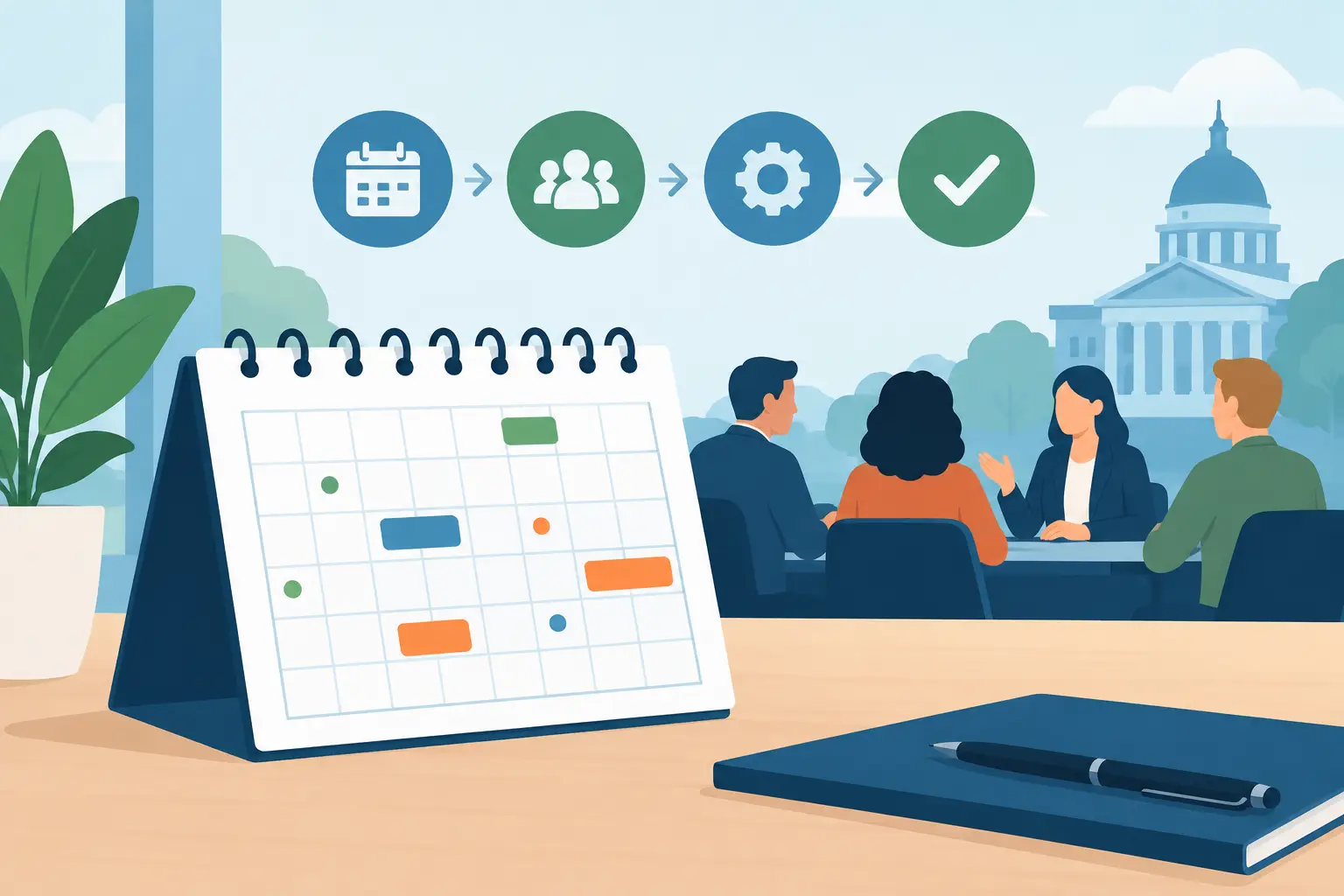
A city decision rarely begins with a headline. It often begins with a date, a PDF agenda, and a meeting notice posted to one of many public meeting calendars. By the time a vote, contract, rezoning, budget cut, or agency rule reaches public debate, the formal process may already be well underway.
For New Yorkers trying to follow City Hall without making it a second job, calendars are an early-warning system. They show where decisions will be discussed, who has formal authority, and when the public can enter the record. But a calendar is not a verdict. It is a starting point for verification.
What Public Meeting Calendars Actually Tell You
At their best, public meeting calendars answer four practical questions: which body is meeting, when and where it will meet, what it is scheduled to consider, and how residents can watch or participate. That information can be more valuable than a polished press release because it points to an action before officials can frame the result.
In New York City, relevant meetings are spread across the City Council, its committees, community boards, mayoral agencies, commissions, public authorities, and boards with narrow but consequential powers. A hearing on a housing proposal may involve a community board, the City Planning Commission, the City Council, and possibly a borough president at different stages. Watching only one calendar can leave out the part where public testimony mattered most.
The calendar also establishes a basic accountability record. If an agency says it consulted the public, the notice can help verify whether a meeting was announced with enough time to attend, whether an agenda was available, and whether the session was open, virtual, hybrid, or limited to a specific audience.
Still, do not overread a listing. An item on an agenda may be postponed, amended, withdrawn, or discussed without a vote. A meeting that appears routine may contain a consequential item buried in an attachment. The useful question is not simply, “What is happening?” It is, “What decision point does this meeting represent?”
The Meetings That Matter Most in NYC
The answer depends on the issue. Budget oversight looks different from land use. School governance follows a different map from policing, transit, or public health.
For citywide legislation and formal oversight, start with the City Council’s stated meetings, committee hearings, and votes. Committees are often where the substantive questioning occurs. A full Council meeting may produce the final vote, but the earlier committee hearing can reveal objections, revisions, agency commitments, and the likelihood of passage.
For neighborhood development, community board land use committees and full-board meetings are often early signals. They do not hold final authority over every proposal, but their recommendations become part of the public record. The City Planning Commission and City Council then take on distinct roles in the city’s land use process. Treat the sequence as a chain, not as a single event.
For agency policy, look for hearings on proposed rules, procurement reviews, advisory boards, and public meetings convened by departments such as housing, sanitation, transportation, or health. These can be less visible than a Council hearing, yet they may determine how a mayoral priority operates in practice.
Public authorities deserve separate attention. The MTA, for example, is not a New York City agency, even though its decisions shape daily life in the city. Its board calendar, committee materials, and public-comment procedures follow a different governance structure. The same is true of many state-controlled or quasi-public entities. Jurisdiction matters because it tells you who can actually change the outcome.
How to Read a Meeting Notice Like a Record
A meeting notice has three layers: logistics, agenda, and authority. Read all three.
Logistics determine whether participation is real. Confirm the date and start time, but also check the location, remote access instructions, registration requirement, language access, and rules for speaking. A notice may list a meeting as public while requiring advance sign-up for testimony. Some bodies accept written comments until a stated deadline; others take them only at the meeting.
The agenda tells you what is formally before the body. Generic labels such as “new business” or “agency update” are weak signals. Specific item numbers, bill numbers, application numbers, contract titles, or proposed rule references are stronger. Save them. They make it possible to find later amendments, minutes, transcripts, voting records, and final actions.
Authority is the most overlooked layer. A community board may advise. A commission may recommend. A Council committee may hold a hearing but not issue final approval. An agency may collect comments before the commissioner acts. Knowing the body’s role prevents a common mistake: treating public testimony at one meeting as the last chance to influence a decision when another, more decisive vote is still ahead.
A Practical Tracking Method
You do not need to monitor every government calendar. Build a watchlist around the institutions that control the issues you care about, then use the same repeatable process each week.
First, identify the decision-maker. If the question is whether a promised program was funded, the relevant record may be a budget hearing, a Council finance document, a procurement notice, or an agency implementation update. If the question is whether a development proposal will advance, map the land use process and identify its next formal stop.
Second, save the source materials before the meeting. Capture the notice, agenda, attachments, and public-comment instructions. Calendar entries can change. An archived copy lets you compare what was initially noticed with what was ultimately discussed.
Third, attend or watch with a narrow purpose. Do not try to document every exchange. Listen for commitments, deadlines, changes in scope, estimates, and unresolved objections. Who was asked to provide a number? What information was missing? Did an official say a decision had already been made, or that a plan remained under review?
Fourth, check the post-meeting record. Look for minutes, a video archive, testimony, a transcript, a vote sheet, an adopted resolution, or revised materials. This is where a scheduled item becomes an accountability item. The distinction is simple: a calendar proves a meeting was planned; a final record helps establish what occurred.
For recurring issues, keep a short timeline with the meeting date, body, stated action, source document, and next deadline. That structure is more useful than a folder full of screenshots. It also makes stalled promises visible. A proposal that appears on three agendas without a recorded decision is not necessarily dead, but it is no longer just “in progress.”
What Can Go Wrong
Government calendars are public records tools, not perfect databases. Notices are sometimes posted late, attachments can be incomplete, links can fail, and meeting times can shift. Emergency meetings and last-minute agenda changes complicate the picture further.
There is also a transparency gap between formal availability and practical access. A meeting held during work hours, with limited remote participation or unclear translation services, may be technically open while remaining difficult for many residents to follow. Tracking access conditions is part of oversight, not a side issue.
Finally, not every meaningful decision occurs in a public meeting. Negotiations, internal agency review, and political bargaining may shape an outcome before the public session. That is not a reason to dismiss the calendar. It is a reason to pair it with budgets, executive orders, legislative text, procurement records, and subsequent implementation data.
Turn Dates Into Public Oversight
The strongest use of public meeting calendars is not passive consumption. It is preparation. A resident can submit targeted testimony. A reporter can ask an agency about a promised document before a vote. A nonprofit can alert affected communities before a hearing deadline passes. A Council office can compare an agency’s meeting statement with its budget request.
ReviewMamdani.com approaches city government as a record that can be checked over time: promise, action, evidence, outcome. Calendars belong near the beginning of that chain. They show when government is about to make itself observable.
Pick one issue that affects your block, commute, school, rent, or workplace. Find the next meeting with authority over it, read the agenda before the session begins, and write down one question the public record should answer afterward. That is how a date on a calendar becomes a tool for accountability.