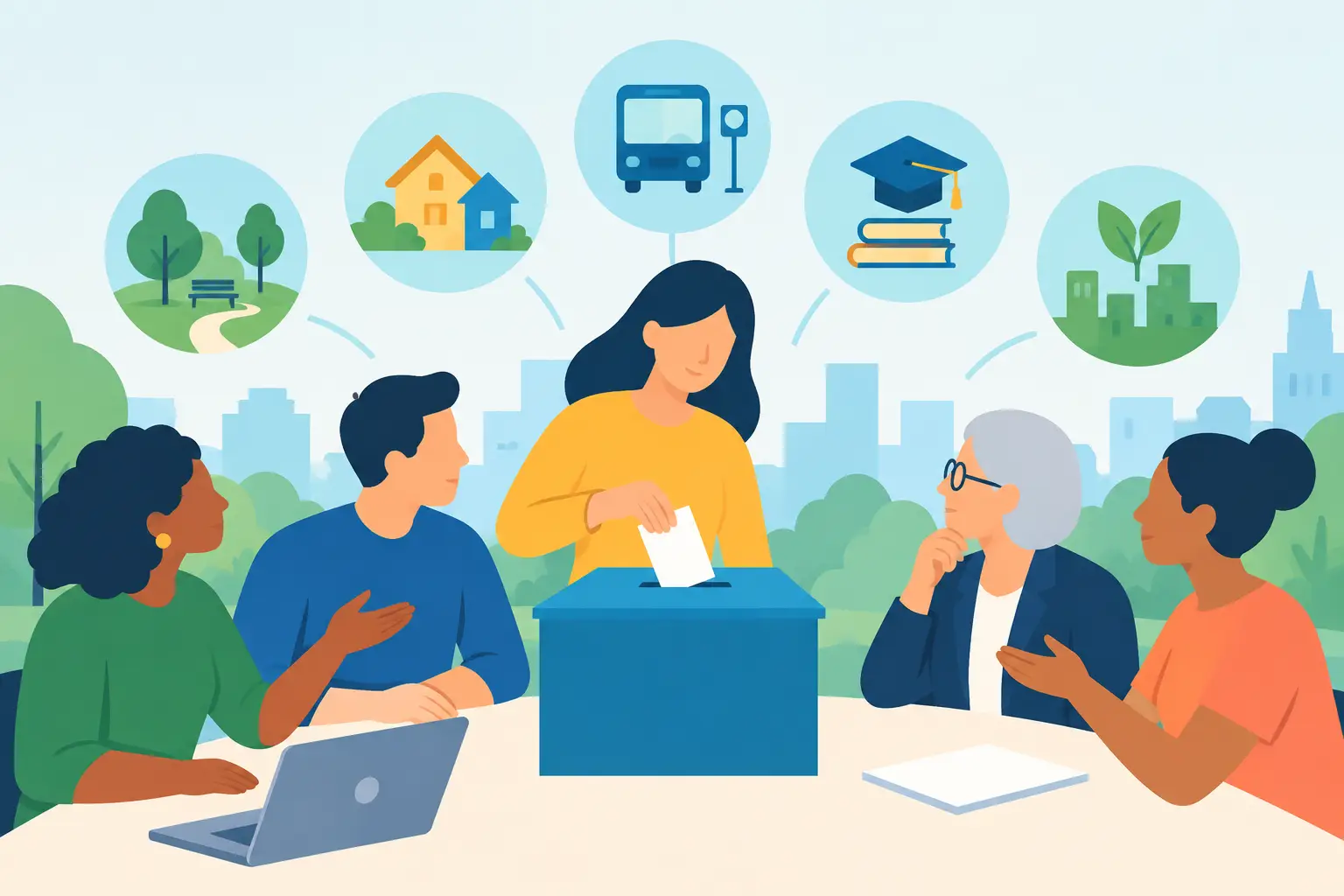
A street needs safer crossings. A public school needs air conditioners. A park needs lights that work after sunset. Under participatory budgeting, residents can help decide which of those needs receives public money - and which must wait.
That is a meaningful shift, but it is not a blank check for direct democracy. Participatory budgeting usually gives the public authority over a defined pool of funds, within rules set by elected officials and government agencies. The central accountability question is not simply whether people get to vote. It is whether the process moves money, reaches the people most affected by public spending, and delivers the projects voters approved.
What participatory budgeting actually is
Participatory budgeting is a public process through which residents propose, develop, and vote on spending projects. The model began in Porto Alegre, Brazil, in 1989 and has since been adapted by cities, school systems, housing authorities, and local elected offices across the United States.
In a typical local cycle, an elected official or public agency sets aside a specified amount of capital or discretionary funding. Residents identify local needs. Volunteer budget delegates or staff turn viable ideas into formal proposals, usually with cost estimates and agency review. The public votes. Projects with enough support are funded until the available money runs out.
The distinction between proposing and funding matters. A resident may propose a new playground, but the city still has to determine whether it owns the site, whether the project is legally eligible, how much it will cost, and which agency will maintain it. A winning ballot item is a public commitment, not an instant construction order.
Why it matters in New York City
New York City government spends far more money through the citywide budget than through participatory processes. The mayor proposes the annual executive budget. The City Council negotiates and adopts it. Agencies administer the resulting programs and contracts. That larger system determines the scale of funding for housing, schools, sanitation, public safety, health care, and many other core services.
Participatory budgeting generally operates on a smaller scale, often through individual Council members' discretionary capital allocations. Capital funds are used for long-lived physical improvements: technology in schools, renovations at public libraries, equipment for parks, street-safety upgrades, or accessibility improvements. They are not typically used for recurring operating costs such as hiring permanent staff or expanding a year-round service.
That limitation does not make the process trivial. For a neighborhood organization trying to secure security cameras, a school community seeking upgraded science labs, or residents who have spent years asking for a safer intersection, a few hundred thousand dollars can be consequential. The process also creates a visible record of local priorities that City Hall, agencies, journalists, and advocates can measure against later.
But residents should be clear about the scale. A participatory budgeting vote is not a referendum on the entire city budget. It does not replace Council budget hearings, agency oversight, or the mayor's responsibility to propose a balanced spending plan. It is one channel of public influence inside a much larger fiscal system.
The process has several decision points
The public-facing ballot is the most visible part of participatory budgeting. It is not the only point where power is exercised.
First, someone decides whether to fund the process and how much money to place under a public vote. A $1 million allocation and a $5 million allocation create very different stakes. Second, the rules determine who can participate. Some programs allow teenagers, noncitizens, or people who live, work, study, or own a business in the district to vote. Others apply narrower eligibility standards.
Third, agencies determine feasibility. This is necessary: public funds cannot be committed to a project the city cannot legally build, maintain, or procure. Yet feasibility review can also narrow the ballot substantially. A proposal may be rejected because it falls outside a funding category, involves property the city does not control, conflicts with an existing capital plan, or would create operating costs without a funding source.
Finally, implementation determines whether a winning project becomes a real improvement. Capital work can take years because of site assessment, design, procurement, permitting, construction, and coordination among agencies. A project approved by voters in one fiscal year may not be completed for several more. That delay is not automatically evidence of failure. It is, however, a reason to track milestones rather than treat a ballot win as the end of the story.
What a credible process should show
A participatory process earns trust when the public can follow the money from allocation to completion. The basic record should be available without requiring residents to decode budget jargon or submit records requests.
At minimum, officials should disclose the total amount available, the source of the funds, project eligibility rules, proposal costs, agency feasibility determinations, vote totals, and the final list of funded projects. After the vote, the record should identify the responsible agency, expected timeline, current status, revised cost if applicable, and any reason a project has been delayed, changed, or canceled.
This is where civic participation meets ordinary fiscal accountability. A project that won a vote but never entered an agency capital plan is stalled. A project completed at a substantially higher cost deserves an explanation. A canceled project should not quietly disappear from a webpage after the next voting cycle.
For residents, the useful question is not just, “Did my project win?” It is also, “What happened after it won?” Public participation without public follow-through can become a trust-building exercise in reverse.
Participation is not automatically representative
Participatory budgeting is often described as more democratic because it opens a direct route from residents to spending decisions. It can be. But turnout patterns matter.
People with flexible schedules, strong ties to local institutions, reliable internet access, or familiarity with government processes may find it easier to attend idea-collection meetings and vote. Well-organized groups can mobilize support for worthy projects, but they can also dominate a small electorate. A neighborhood with low turnout may receive less investment even when its needs are greater.
The design choices are consequential. Outreach through schools, libraries, tenant associations, senior centers, faith communities, and language-access partners can broaden participation. Paper ballots, mobile voting locations, translated materials, and clear eligibility rules can reduce barriers. So can publishing turnout data by neighborhood or precinct where privacy can be protected.
There is also a trade-off between accessibility and verification. Lowering barriers can include more residents who are affected by local decisions but excluded from formal voting rolls. At the same time, programs need credible safeguards against duplicate votes and organized manipulation. There is no single correct formula. The standard should be transparent rules that match the program's purpose and are applied consistently.
What participatory budgeting cannot fix
A well-run process can identify overlooked needs and give residents a tangible role in public spending. It cannot, by itself, resolve structural inequities created by the broader budget.
If a district has aging public housing, overcrowded schools, under-resourced parks, and inadequate transit access, a limited discretionary allocation will not close that gap. Nor should participatory budgeting become an excuse for agencies to shift basic maintenance obligations onto neighborhood competitions. Residents should not have to win a vote to receive repairs that government was already responsible for making.
This is the key test: is the process funding community priorities beyond the baseline, or is it asking residents to compete for essentials? The answer may differ by project and by district. It deserves scrutiny in every cycle.
How to evaluate a local program
A useful evaluation begins with four records: the amount committed, the people reached, the projects selected, and the projects completed. Those measures reveal more than a celebratory announcement ever will.
Look at whether the allocation is stable from year to year, whether voting is accessible to residents who are usually left out, and whether the ballot offers genuine choices rather than a pre-screened set of agency preferences. Then check implementation. Are projects assigned to agencies? Are target dates public? Are cost changes explained? Are prior winners still pending while officials promote a new round of voting?
For elected officials, participatory budgeting creates a measurable promise: share decision-making, then carry out the result. For agencies, it creates a test of responsiveness and delivery. For the public, it is an opportunity to make priorities visible - and to keep watching after the ballots are counted.
The vote is the beginning of the accountability record. The real measure is whether a resident can walk past the completed project years later and see that public money followed the public decision.