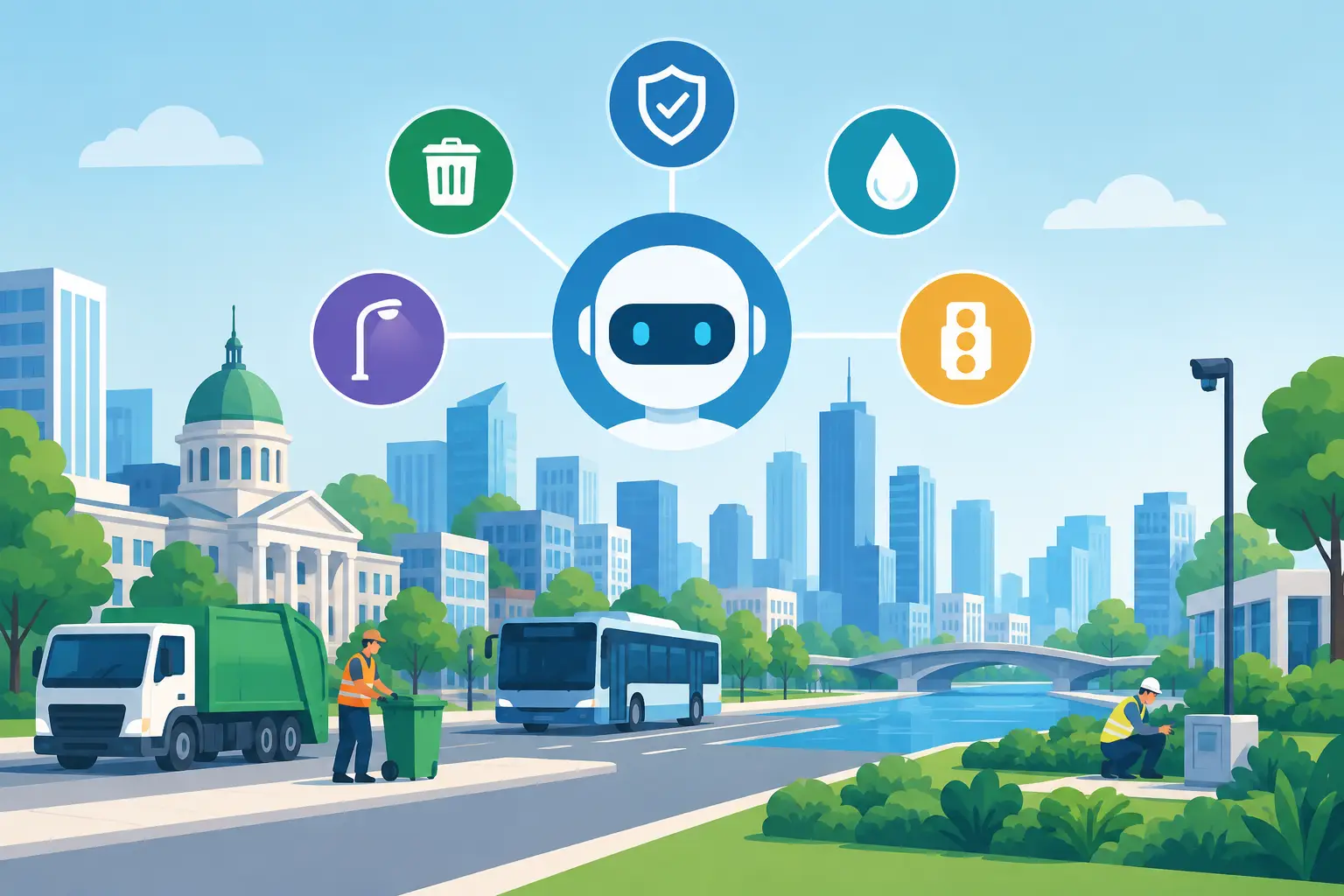
A missed housing inspection, an unanswered 311 complaint, or a benefits application stuck in a queue is not an abstract service failure. It is a resident losing time, money, or trust. Municipal AI may help cities sort those problems faster. It may also make a bad decision harder to see, challenge, and reverse.
That is the central test for any city government considering artificial intelligence: does the system improve public service without weakening public accountability? The answer depends less on whether a tool is branded as AI than on what it does, what data it uses, and who remains responsible when it gets something wrong.
Municipal AI is not one thing
The phrase municipal AI covers a wide range of tools with very different risk levels. A chatbot that helps a resident find a sanitation pickup schedule is not the same as a model that flags families for benefits fraud. An internal tool that summarizes public comments is not the same as software that recommends where police officers should be deployed.
Cities often group these uses together because they share vendors, data systems, or a broad modernization agenda. Residents should resist that framing. The relevant question is not whether a city is "using AI." It is whether a particular system is making, shaping, or merely assisting a public decision.
A useful distinction has three parts. First, some tools handle routine communication: answering common questions, translating forms, or routing requests to the right agency. Second, some tools help staff analyze large volumes of information: identifying duplicate records, forecasting repair demand, or summarizing meeting testimony. Third, some systems influence decisions about enforcement, eligibility, inspections, hiring, or the allocation of scarce public resources.
The further a tool moves into the third category, the higher the standard should be. A wrong answer about park hours is inconvenient. A wrong risk score attached to a tenant, driver, student, or small business can carry real consequences.
Where cities can gain ground
Municipal government is full of repetitive work. Staff search across disconnected databases, manually classify incoming requests, and spend hours turning public records into usable reports. Carefully designed automation can reduce that burden.
For residents, the strongest early applications are usually administrative and reversible. A city might use a language model to draft plain-English explanations of a permit process, with staff review before publication. It might use machine learning to identify likely duplicate 311 reports so crews see the full scale of a problem. It might forecast which water mains are most likely to fail, helping agencies schedule preventive maintenance rather than waiting for an emergency.
These uses can produce measurable results: shorter wait times, fewer abandoned requests, better targeting of inspections, or more complete public records. But a claimed efficiency is not proof. Agencies should publish a baseline before deployment and report whether the system actually improved performance after deployment.
If an AI tool is supposed to reduce call-center wait times, the public should be able to see the prior wait time, the current wait time, the abandonment rate, and the share of residents who still need a human agent. If a tool is supposed to improve pothole response, publish the response-time data by neighborhood. A city cannot call a system successful simply because it was purchased or used.
Automation should not become a service cut
There is a familiar municipal temptation: present automation as innovation, then use it to justify fewer people answering phones or reviewing complicated cases. That trade-off may look efficient in a budget presentation while shifting costs onto residents who have limited internet access, limited English proficiency, disabilities, or unusual circumstances.
A well-designed system gives people a faster route to help while preserving a clear human route when automation fails. It should not require a resident to master a chatbot before speaking with a person. Nor should it turn an agency's inability to staff its public-facing functions into a technical problem for residents to solve.
The accountability risks are concrete
The biggest risk is not that a chatbot writes an awkward sentence. It is that governments rely on automated recommendations without being able to explain the evidence, test the outcomes, or correct the record.
Public agencies make decisions under legal duties that private companies do not always face. They must follow due process, disclose records, apply rules consistently, protect personal information, and avoid discrimination. An opaque vendor system does not erase those obligations.
Consider a tool that ranks properties for inspection. If it relies heavily on complaint data, it may steer enforcement toward neighborhoods where residents have more time, confidence, or access to reporting systems. If it relies on historic enforcement data, it can reproduce earlier enforcement patterns without proving that current risk is higher. The system may appear neutral because it uses numbers. That appearance can be misleading.
Generative AI creates a separate problem: confident fabrication. A system can invent a policy, misstate an eligibility rule, or summarize a public document inaccurately. In city government, a false answer can send someone to the wrong office, cause a missed deadline, or distort public understanding of an official action.
For high-impact uses, agencies should not treat a model output as a decision. It is a recommendation that requires trained human review, documented reasoning, and a way for affected people to contest the outcome.
What public oversight should require
A city does not need to publish source code for every technology tool. It does need to publish enough information for residents, journalists, advocates, and oversight bodies to assess how government power is being used.
At minimum, every significant municipal AI system should have a public record identifying the agency, vendor, purpose, affected population, data sources, launch date, contract value, and accountable official. The record should say whether the system makes a final decision, recommends an action, or performs an administrative task.
Before deployment, the agency should conduct and publish an impact assessment. That review should identify foreseeable errors, privacy risks, bias risks, and the process for human intervention. It should also identify groups likely to be affected differently. A generic assurance that a vendor tested its product is not enough.
After deployment, oversight needs to continue. Agencies should report error rates, appeals, overrides by staff, complaints, and performance by neighborhood or relevant demographic category when legally and statistically appropriate. A system can meet an average target while failing a specific community. Aggregate success is not a complete answer.
Independent auditing matters too. The agency operating a tool has an understandable interest in defending it. Inspectors general, comptrollers, legislative bodies, and qualified outside reviewers can test claims that an agency may not be positioned to test on its own. Procurement contracts should preserve audit rights and require vendors to cooperate with public-records and investigation requirements.
Procurement is where many protections are won or lost
The public often learns about a technology system after it is already operating. By then, key terms may be buried in a contract: who owns the data, whether it can be reused to train a vendor's models, what happens after a breach, and whether the city can inspect how the system works.
Those are governance decisions, not technical footnotes. Cities should prohibit vendors from using sensitive resident data beyond the contracted purpose without explicit authorization. They should require deletion or secure return of data at the end of a contract. They should also avoid terms that let a vendor invoke trade secrecy to block meaningful public scrutiny of a system used to exercise government authority.
Cost deserves the same scrutiny. The relevant figure is not only the initial software price. It includes data cleanup, integration, staff training, cybersecurity, ongoing licenses, outside consultants, and the cost of correcting errors. A pilot that appears inexpensive can become a long-term dependency if the city cannot move its data or operate without a single vendor.
Questions residents should ask
When an agency announces an AI initiative, the first question should be plain: what decision or service is changing? From there, accountability becomes more specific.
Ask what data the system uses and whether residents can correct inaccurate information. Ask whether a person can review an automated result before it affects benefits, enforcement, housing, education, or employment. Ask how the agency will measure success, what it will publish, and what happens if the tool fails. Ask who can pause or terminate the system.
These questions are not anti-technology. They are basic public management. Cities routinely set performance targets for contracts, capital projects, and service delivery. AI systems should face the same standard, especially when they can scale an error across thousands of residents quickly.
The standard is visible responsibility
Municipal AI can help government process work that has long been slow, fragmented, and hard for residents to navigate. It cannot substitute for clear rules, adequate staffing, or officials willing to own the results of their decisions.
The public should be able to identify the system, the official responsible for it, the evidence that it works, and the route to challenge it when it does not. That is the practical civic standard: technology may accelerate government, but it must never make government less answerable.