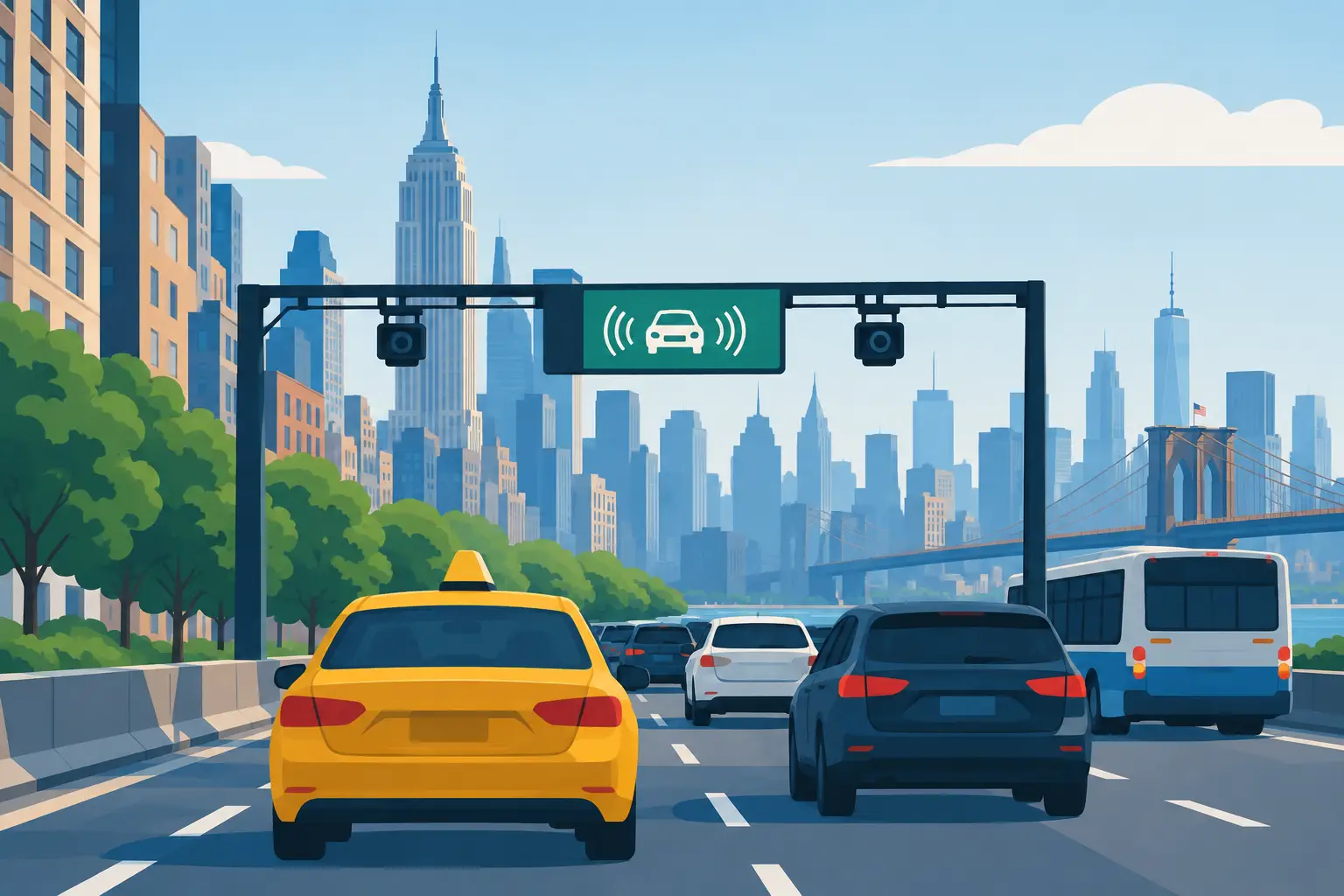
New York City is the clearest recent congestion pricing rollout example in the United States because the policy did not move in a straight line. It cleared years of planning and federal review, was halted weeks before its scheduled start, then returned in a revised form. For residents, the lesson is not simply that the toll began. It is that a major city policy can be legally approved, operationally ready, politically vulnerable, and still subject to redesign.
The Congestion Relief Zone tolling program began on January 5, 2025. Most passenger vehicles entering Manhattan south of 60th Street during the day are charged a base E-ZPass rate of $9. The program was initially expected to launch at a higher $15 rate in June 2024. That change matters. A rollout is not a single date on a calendar. It is a chain of decisions involving state government, the Metropolitan Transportation Authority, federal agencies, courts, vendors, transit riders, drivers, and neighborhood communities.
The congestion pricing rollout example: New York's timeline
New York's path began with state authorization. The 2019 state budget created the legal framework for a congestion tolling program and directed the MTA to establish a Central Business District Tolling Program. The policy had two stated purposes: reduce vehicle traffic in the most congested part of Manhattan and produce a dedicated revenue stream for transit capital improvements.
The MTA then spent years on environmental review, public hearings, traffic modeling, toll design, exemptions, discounts, and technology procurement. The Federal Highway Administration approved the environmental assessment in June 2023. Toll rates and credits were approved by the MTA's Triborough Bridge and Tunnel Authority board in March 2024, setting the original $15 daytime E-ZPass rate for most passenger cars.
By spring 2024, gantries and cameras were installed, billing systems were being prepared, and the agency set a June 30 start date. Then, on June 5, Governor Kathy Hochul announced an indefinite pause, citing affordability concerns. The infrastructure remained in place, but the operational decision changed.
In November 2024, the governor announced a revised proposal with a $9 base toll. The MTA board approved the revised schedule later that month. After additional litigation and administrative steps, the program opened in January 2025.
That sequence is worth tracking because each milestone answers a different accountability question. Legal authority is not the same as federal approval. Federal approval is not the same as equipment readiness. Equipment readiness is not the same as political commitment. And a launch does not settle whether the program is meeting its public goals.
What was actually implemented
The program uses license-plate readers rather than physical toll booths. Drivers entering the Congestion Relief Zone are billed through E-ZPass or by mail. The zone covers Manhattan south of and including 60th Street, though certain roadway segments are excluded from the tolling area.
The $9 rate applies to most passenger vehicles with E-ZPass during the daytime charging period. Rates vary by vehicle type, time of day, and payment method. Trucks pay more. Motorcycles pay less. Some drivers receive crossing credits when they have already paid tolls at certain tunnels. There are also limited exemptions and discounts, including a low-income discount program and an exemption category for qualifying vehicles transporting people with disabilities.
Those details are not administrative footnotes. They determine who bears the cost and whether the policy operates as promised. A headline rate alone cannot answer whether taxi riders see surcharges, whether outer-borough drivers have workable alternatives, or whether traffic shifts to streets just outside the zone.
The rollout should be judged on four measurable tests
Supporters and critics may disagree about the policy's merits. The public can still agree on what should be measured. The rollout should be evaluated against stated outcomes, not treated as a permanent political argument with no scoreboard.
1. Traffic and travel time
The central claim is that charging for entry will reduce vehicle volumes in the zone and make trips more reliable. The key comparison is not one unusually quiet day against one unusually busy day. Analysts should compare traffic counts, average speeds, and travel times across equivalent days, seasons, weather conditions, and major events.
The more difficult question is displacement. If traffic falls inside the zone but rises sharply in the Bronx, Queens, Brooklyn, New Jersey approaches, or boundary streets near 60th Street, the city and state should report that plainly. A program can improve conditions in one area while shifting burdens elsewhere. Both results can be true.
2. Transit reliability and ridership
A congestion program earns public credibility when people have viable alternatives to driving. That makes bus performance especially important. Faster bus trips through Midtown and Lower Manhattan would directly reflect reduced street congestion, while subway and commuter rail ridership can indicate whether travel behavior is changing.
But ridership is influenced by many factors: employment patterns, fare changes, service disruptions, weather, tourism, and the broader economy. The MTA should avoid assigning every change to congestion pricing. A credible assessment distinguishes correlation from evidence.
3. Revenue and capital delivery
The toll was designed to generate money for the MTA's capital program, supporting projects such as signal modernization, accessibility improvements, new buses, and state-of-good-repair work. Revenue reporting should show gross collections, administrative costs, enforcement outcomes, debt-service commitments, and the specific capital projects funded.
This is where the pause had a practical consequence. The MTA had anticipated congestion-pricing revenue to support borrowing for its capital plan. When the launch was halted, the agency identified projects that could be delayed or reconsidered. Residents should be able to see whether renewed toll revenue translates into completed improvements, not merely projected financing.
4. Equity, health, and local impact
A fair review also asks who pays, who benefits, and who experiences unintended effects. Lower-income drivers who must enter the zone, taxi and for-hire vehicle passengers, small businesses, people with disabilities, and workers on late-night shifts may face different impacts than a commuter with reliable rail access.
Air quality deserves similar scrutiny. Fewer vehicles in Lower Manhattan may reduce local emissions, but diverted traffic can create concerns in other neighborhoods. Public reporting should use neighborhood-level data where possible and should not rely solely on citywide averages.
Why the pause is part of the policy record
It would be inaccurate to describe New York's rollout as either a clean success or a simple failure of political will. The 2024 pause exposed a real governance problem: a program can be substantially built before its final political and financial terms are secure.
For watchdog purposes, the pause belongs in the record alongside the launch. It affected MTA planning, contractors, capital commitments, public trust, and the expectations of drivers who had prepared for a June start. The later $9 rate also created a new factual question: whether the revised toll will generate enough revenue to support the intended capital program at the same pace.
That is not an argument for or against the lower rate. It is an accountability item. If projected revenue changes, financing assumptions and project schedules should be updated in public.
What residents should watch next
The most useful documents will not always be press releases. Watch the MTA's traffic, revenue, and capital-program reporting; board materials; state budget actions; environmental monitoring; and court decisions that could alter the program's operation. Look for consistent definitions and comparable time periods. A monthly count of vehicles is less useful if the agency changes its measurement method without explanation.
Also watch whether officials report unfavorable findings with the same clarity as favorable ones. If bus speeds improve but boundary-area traffic worsens, both should appear in the public record. If collections lag projections, the agency should explain whether the cause is lower traffic, discounts, compliance issues, or changes in the toll structure.
New York's experience shows why government performance cannot be judged only at announcement or launch. The real test is whether the policy's claims, costs, and trade-offs remain visible after the cameras are installed and the political attention moves on.